
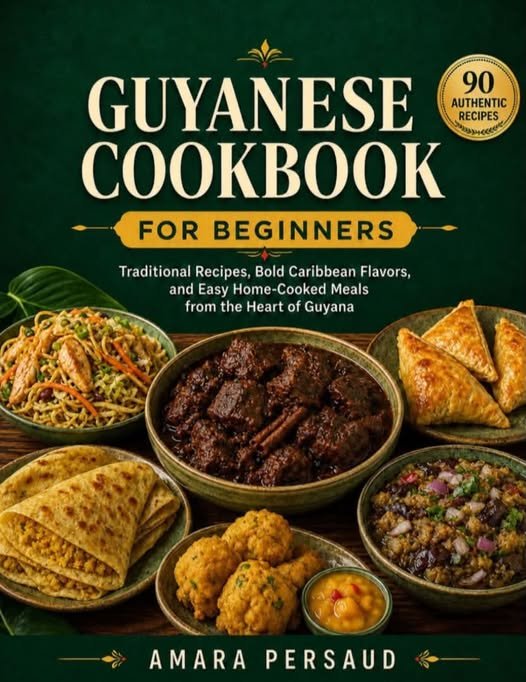
Guyanese Cookbook for Beginners
A practical introduction to the flavours of Guyana
Book Details
Full Title: Guyanese Cookbook for Beginners: Traditional Caribbean Recipes, Authentic Guyanese Flavors, and Easy Home-Cooked Meals for Every Occasion
Author: Amara Persaud
Format: Kindle Edition
Publication Date: August 21, 2026
Number of Recipes: 90
Available From: Amazon
About the Book
Guyanese Cookbook for Beginners presents itself as an accessible introduction to Guyanese home cooking. The collection contains 90 recipes and promises traditional Caribbean dishes, authentic Guyanese flavours and uncomplicated meals suitable for everyday cooking.
Its strongest selling point is right there in the title: this is a book for beginners.
Guyanese food can sometimes appear intimidating to someone preparing it for the first time. Recipes are often shared orally, measured by instinct and explained through phrases such as “a little bit,” “until it looks right” or “season to taste.” Experienced Guyanese cooks understand those instructions perfectly. A beginner may not.
A cookbook that translates those inherited methods into clear, approachable steps could be genuinely useful, particularly for younger Guyanese and members of the diaspora who want to reconnect with the food they grew up eating.
What You’ll Find Inside
The book’s description promises a broad collection inspired by Guyana’s culinary heritage, including satisfying curries, roti and familiar home-cooked meals.
With 90 recipes, the book appears designed to offer more than a small selection of celebrated dishes. Its focus on approachable cooking suggests that the recipes are intended for ordinary kitchens rather than professional chefs.
That makes the book potentially valuable for:
- Beginners exploring Guyanese cooking
- Guyanese living overseas
- Young adults learning family dishes
- Caribbean food enthusiasts
- Home cooks looking for new flavours
- Families trying to preserve culinary traditions
Signature Recipes
The public description specifically highlights curries and fluffy roti, two essentials in many Guyanese homes. These are sensible choices for a beginner-focused collection because they introduce readers to some of the techniques that define Guyanese cooking, including seasoning, spice preparation, dough handling and balancing flavour.
However, the accessible listing does not provide a complete table of contents or identify enough individual recipes for us to confidently name the book’s true standouts. We would like to see dishes such as pepperpot, cook-up rice, metemgee, dhal puri, pholourie, pine tart, black cake and other staples represented, but it would be irresponsible to claim that they are included without examining the complete book.
Why We Recommend It
The idea behind Guyanese Cookbook for Beginners is timely and worthwhile.
Many Guyanese recipes remain scattered across family notebooks, handwritten scraps, social-media videos and memories. A beginner-friendly collection can help turn those memories into meals and give new cooks the confidence to enter the kitchen.
The book may also introduce Guyanese cuisine to readers who know Caribbean food mainly through Jamaican or Trinidadian dishes. Guyana’s culinary identity is distinctive, and every well-produced book that makes it easier to discover deserves attention.
Still, accessibility alone is not enough. A strong Guyanese cookbook should respect the origins of the dishes, use culturally accurate names and explain the traditions surrounding the food. Based on the limited public preview, we cannot yet judge how successfully this book accomplishes those things.
Best For
This cookbook appears best suited to readers who are new to Guyanese cooking and want a broad starting point rather than an advanced culinary reference.
More experienced Guyanese cooks may use it for inspiration, but they are also the readers most likely to notice differences in terminology, ingredients and preparation methods. As every Guyanese family knows, debates about the “right” way to cook curry, roti or cook-up rice can become lively very quickly.
Taste Guyana Rating
First-Look Rating: 3.5 out of 5
The generous recipe count and beginner-friendly concept are promising. However, Taste Guyana cannot give the book a definitive rating without examining the complete recipes, testing selected dishes and verifying the cultural accuracy of the content.
We would also have preferred a clearer author biography and more information about the author’s connection to Guyanese cuisine.
Did You Know?
Guyanese cuisine cannot be reduced to one culinary tradition. It reflects centuries of cultural exchange among Guyana’s Indigenous peoples and the African, Indian, Chinese, Portuguese and European communities that helped shape the country.
That diversity is why one Guyanese table can comfortably hold curry, chow mein, pepperpot, cook-up rice, cassava bread and baked pastries, each with its own history.
Taste Guyana Verdict
Guyanese Cookbook for Beginners has the potential to become a useful entry point for anyone curious about Guyanese food. Its promise of 90 approachable recipes gives readers plenty to explore, while its emphasis on home cooking keeps the concept grounded in the way Guyanese food is most often experienced: around a family table.
But cultural cookbooks carry a responsibility that goes beyond assembling recipes. They help define a country’s cuisine for readers who may have no other reference. Authenticity, proper attribution and a demonstrated connection to the culture therefore matter.
For now, we see this as a promising beginner’s collection rather than a definitive guide to Guyanese cooking. It may help new cooks take their first steps, but a full Taste Guyana recommendation should wait until the recipes themselves can be examined and tested.
Available on Amazon: View the cookbook



Leave a Reply
Want to join the discussion?Feel free to contribute!